For most contractors, the workers’ compensation premium on the policy is only an estimate. The real number arrives months after the policy ends, when the audit comes back. If payroll was assigned to the wrong class code or a subcontractor’s certificate is missing from the file, that bill can be larger than the original premium.
This guide covers how the audit works, the problems auditors find most often in contractor files, what is different in New York, New Jersey and Maryland, and the records to have ready.
How a workers’ comp audit works
Your premium is calculated from payroll in each job classification, multiplied by the rate for that class, and adjusted by your experience modification factor. At the start of the policy, those numbers are estimates. After the policy period ends, the insurance company audits what actually happened.
The auditor typically reviews payroll records, tax filings, the class code assigned to each employee, and every payment you made to subcontractors. The final premium is then recalculated. If payroll was lower than estimated, you may receive a refund. If it was higher, or if payroll moves into a higher-rated class, you receive an additional premium bill.
Plan for the audit before it arrives. Audits usually begin within a few months of the policy's expiration date. The time to organize records is during the year, while job details and subcontractor paperwork are still easy to find.
The problems auditors find most often
These are the issues that most often turn a contractor’s audit into an unexpected bill:
- Uninsured subcontractors. Payments to a subcontractor with no valid certificate on file can be added to your payroll and charged at your rates.
- Payroll in the wrong class. Field employees are rated at construction class rates. If records do not separate field work from clerical or estimating work, the auditor may place everyone in the higher class.
- Employees who work in more than one trade. Splitting one person's payroll between classes generally requires records of the hours or wages for each type of work.
- Overtime. Many states allow the premium portion of overtime to be excluded from payroll for rating, but only if your records show it separately.
- New trades or new states. Work added during the year that was never reported to the insurance company shows up at audit.
- Owners and officers. Whether an owner or officer is included or excluded depends on the entity type, the state and the elections on file. Confirm this at the start of the policy, not at audit.
Subcontractor certificates
For contractors who rely on subcontracted labor, the certificate file is the single largest audit issue. Before any subcontractor starts work:
- Collect a current certificate showing workers’ compensation and general liability.
- Check that the policy dates cover the entire time the subcontractor works for you.
- Request a new certificate when a subcontractor’s policy renews during your policy year.
- Keep a written agreement and invoices for each subcontractor, with the business name matching the certificate.
A one-person subcontractor without employees may not need workers’ compensation, but you still need documentation. In New York, that is usually a CE-200 exemption certificate. Without it, the auditor may treat that person as your employee.
What is different in each state
New York
New York employers must carry workers' compensation and also provide disability benefits and Paid Family Leave coverage for eligible employees.
- State proof-of-coverage forms. Building departments and government agencies require New York's own forms: the C-105.2 or U-26.3 (from the New York State Insurance Fund) for workers' compensation and the DB-120.1 for disability and Paid Family Leave. ACORD certificates are not accepted for these purposes.
- CE-200 exemptions. A contractor with no employees can apply to the Workers' Compensation Board for a CE-200 certificate of exemption, which permit offices and general contractors often require.
- Construction Industry Fair Play Act. In construction, a person you pay is presumed to be your employee unless they meet the law's test for an independent contractor or a separate business entity.
- Rating bureau. Class codes and experience modification factors in New York are set by the New York Compensation Insurance Rating Board (NYCIRB).
New Jersey
New Jersey requires workers' compensation for virtually all employers, and the state has become one of the most active in enforcing worker classification on construction sites.
- Stop-work orders. The New Jersey Department of Labor can issue stop-work orders for misclassification and related violations, including failure to carry required insurance, and can assess civil penalties of $5,000 per day against an employer that keeps working in violation of an order.
- Misclassification is a focus. The department has issued stop-work orders on construction projects throughout 2025 and 2026, often against subcontractors. A general contractor's job can stall when a subcontractor is shut down.
- Rating bureau. Class codes and experience modification factors are set by the New Jersey Compensation Rating and Inspection Bureau (NJCRIB).
Maryland
Maryland requires workers' compensation for employers with one or more employees.
- Workplace Fraud Act. In construction and landscaping, a worker is presumed to be an employee unless all three parts of the ABC test are met: the worker is free from direction and control, is customarily engaged in an independent business of the same kind, and the work is outside the usual course of your business or performed outside your place of business.
- Penalties. The Maryland Department of Labor can assess penalties of up to $1,000 per misclassified worker for violations not corrected in time, up to $5,000 per worker for knowing violations, and more for repeat violations.
- Rating bureau. Maryland class codes and experience modification factors are administered through NCCI.
Your experience modification factor
The experience modification factor, or mod, compares your claims history to other contractors in the same classes. A mod below 1.0 lowers your premium, and a mod above 1.0 raises it. It is calculated by your state’s rating bureau from several years of payroll and claims.
Errors on the mod worksheet do happen: claims assigned to the wrong employer, reserves that were never reduced after a claim closed, or payroll reported incorrectly. Review your worksheet each year with your producer, and report small injuries promptly so they are handled properly from the start.
What to have ready before your audit
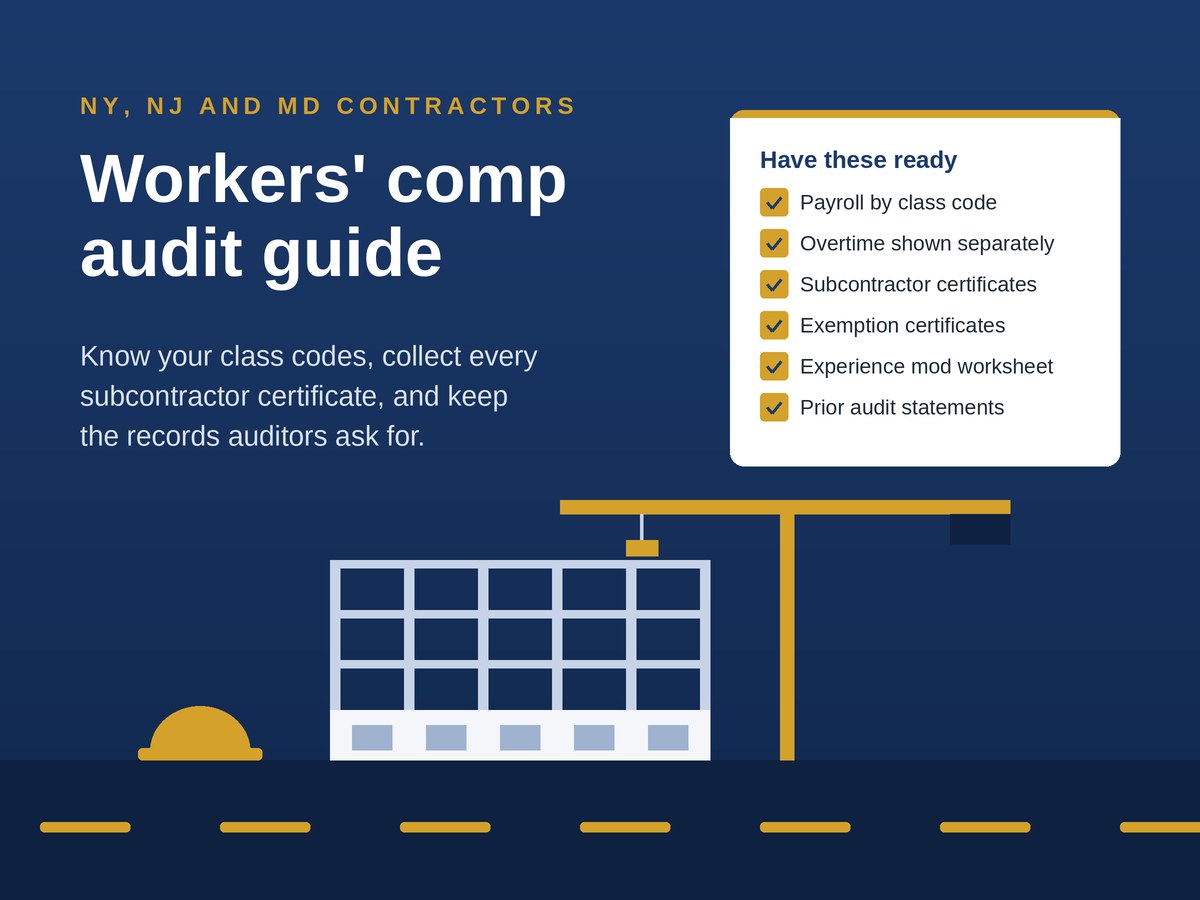
A complete file shortens the audit and gives you documentation if you need to dispute a result:
- Payroll records by employee, broken out by class code and by state
- Quarterly payroll tax filings (Form 941 and state unemployment reports)
- Overtime shown separately from regular wages
- Job descriptions for each employee, including office and field time
- Subcontractor list with payments, invoices and current certificates for the full policy period
- Exemption certificates for any subcontractor without employees
- Your current declarations page and experience modification worksheet
- Three to five years of loss runs
- Prior audit statements, especially any you disputed
Talk with Candor about your workers' comp program
Candor Insurance Brokerage Inc works with general contractors, subcontractors and specialty trades across New York, New Jersey and Maryland. Send us your basics and a licensed producer will review them and follow up.
Or email Sara Glanz. For a deeper look at the program, see our contractors workers' compensation page.
Frequently asked questions
What is a workers' comp audit?
After the policy period ends, your insurance company reviews your actual payroll, class codes and subcontractor payments to calculate the final premium. Your original premium was based on estimates, so the audit can produce a refund or an additional bill.
Why do contractors get charged for their subcontractors?
If a subcontractor cannot show its own workers' compensation coverage for the period it worked for you, the auditor can treat what you paid that subcontractor as your payroll and charge premium on it. A current certificate from every subcontractor, kept on file, usually prevents this.
Is an ACORD certificate enough proof of workers' comp in New York?
Not for New York permits and government contracts. New York requires the state's own forms, such as the C-105.2 or U-26.3 for workers' compensation and the DB-120.1 for disability and Paid Family Leave, or a CE-200 exemption. Many private general contractors still accept ACORD certificates, so check what each job requires.
Can I split an employee's payroll between two class codes?
Often, yes, but only when your payroll records show the hours or wages for each type of work. Without that detail, the auditor will usually assign all of the employee's payroll to the highest-rated class that applies.
What happens if I disagree with my audit?
Ask your insurance company for the audit worksheet, compare it against your records, and send corrections with supporting documents. A licensed producer can help you request a review. Each state also has a rating bureau process for classification disputes.
This article is general information, not legal or tax advice or a statement of coverage. Coverage is subject to the terms, conditions and exclusions of the policy actually issued, and premium is determined by your insurance company's audit and the rules of your state's rating bureau. State requirements and penalties change; confirm current requirements with the New York Workers' Compensation Board, the New Jersey Department of Labor, the Maryland Department of Labor or your attorney. Candor Insurance Brokerage Inc is a licensed insurance brokerage serving clients in New York, New Jersey and Maryland.