Most trucking insurance renewals get handled the same way: the renewal notice arrives a few weeks before the policy expires, the premium is higher than last year, and there’s no time left to do anything except sign. For owner-operators and small fleets in New York, New Jersey and Maryland, a little preparation changes that conversation.
This guide covers what to do and when, the federal minimums, what underwriters look at, the requirements that matter most in this corridor, and a checklist of what to have ready.
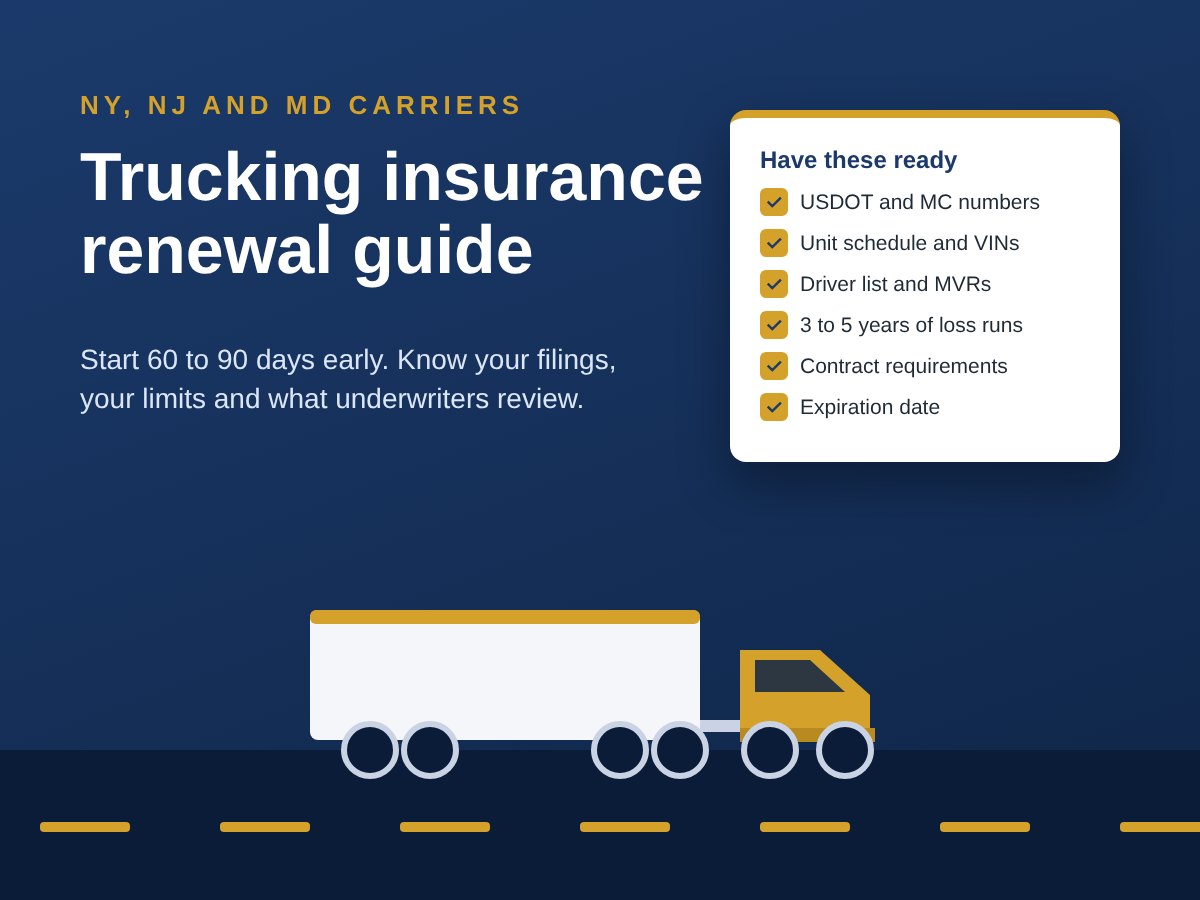
Start 60 to 90 days before your expiration date
A renewal takes longer than most carriers expect. Loss runs from a prior insurer can take a week or more to arrive. Underwriters come back with questions about drivers, units or a past claim. If you want more than one option to compare, each market needs a complete submission and time to respond.
Starting two to three months out gives a licensed producer room to review your current program, go to market if it makes sense, and resolve problems before your coverage dates arrive.
Watch your filing dates. If coverage lapses, your insurer notifies FMCSA, and your operating authority can be revoked if replacement coverage isn't on file in time. Brokers and shippers check your status, so a lapse can stop loads before it stops anything else.
Federal minimum liability limits
FMCSA sets minimum public liability (bodily injury and property damage) limits by what you haul. These are floors, not recommendations:
- General freight, for-hire, vehicles of 10,001 lbs or more: $750,000
- General freight, for-hire, vehicles under 10,001 lbs: $300,000
- Household goods movers, 10,001 lbs or more: $750,000 liability, plus $5,000 in cargo coverage filed with FMCSA
- Certain hazardous materials: $1,000,000
- Explosives, poison gas and radioactive materials: $5,000,000
- Passenger carriers: $1,500,000 for vehicles seating 15 or fewer, $5,000,000 for 16 or more
In practice, many brokers, shippers and equipment providers require more than the federal minimum, commonly $1,000,000 in auto liability along with set cargo limits. Your contracts, not the federal floor, usually decide the limits you need.
How insurance filings work
Your insurance company, not you, files proof of coverage with FMCSA, usually on Form BMC-91 or BMC-91X. Movers also need a cargo filing (BMC-34). If a policy is cancelled, the insurer files a cancellation notice, and the authority that depends on that coverage can be revoked if a replacement filing isn’t in place.
In 2026, FMCSA moved registration and insurance filings to its new Motus registration system. Your USDOT and MC numbers did not change. After any renewal or change of insurer, check FMCSA’s public record to confirm the new filing has posted and your authority shows as active.
What underwriters look at
Every carrier is different, but most trucking underwriters review the same core items:
- Loss history. Three to five years of loss runs. Frequent small claims can matter as much as one large one.
- Drivers. Age, years of commercial driving experience, license status and motor vehicle records for every driver, including new hires.
- Units. Year, make, model, VIN and value for each power unit and trailer.
- Radius and commodities. How far you run and what you haul. A change in either can change your rate and your coverage.
- Safety record. Inspection results, out-of-service rates and CSA scores are public, and underwriters check them.
- Time in business. New authorities usually have fewer options and pay more until they build a record.
What matters in the NY, NJ and MD corridor
Port drayage: New York and New Jersey, and Baltimore
Drayage carriers pulling containers or chassis at the Port of New York and New Jersey or the Port of Baltimore usually sign the Uniform Intermodal Interchange Agreement (UIIA). Its minimum insurance requirements go beyond the federal floor:
- $1,000,000 in auto liability, on an "any auto," "scheduled and hired" or "all owned and hired" policy. A scheduled-only policy does not qualify.
- $1,000,000 in general liability per occurrence.
- Trailer interchange or physical damage coverage for the equipment you pull, with limits set by each equipment provider.
- A hold-harmless endorsement, the equipment provider named as additional insured, and 30 days' notice of cancellation.
Equipment providers may also require cargo and workers' compensation. If you pull intermodal equipment, have your producer review the policy against the UIIA and each provider's requirements before renewal, not after a denied gate move.
Household goods movers
Interstate movers need the federal cargo filing in addition to liability. Customers, building managers and co-op boards in New York and New Jersey also often ask for certificates naming them before a move. Keep a current certificate process in place so a missing certificate doesn't cost you a job.
Dump, construction and materials haulers
Contractors and general contractors commonly require additional insured status, waivers of subrogation and specific limits on both auto and general liability. Pull the insurance section of your hauling agreements before renewal so the policy matches what your customers require.
Issues worth raising with your producer
These come up often in small fleets and are easier to fix before renewal than after a claim:
- Trucks or trailers added or sold during the year and never reported
- New drivers who were never added to the policy
- A longer operating radius or a new commodity since the policy was written
- Owner-operators leased on to another carrier who need non-trucking liability
- Cargo exclusions for unattended vehicles, specific commodities or reefer breakdown
- Contracts that require "any auto" or hired auto coverage when the policy is scheduled-only
What to have ready before you call
A complete file gets a faster answer and gives a producer more markets to approach:
- USDOT and MC numbers and current authority status
- Current declarations pages and certificates of insurance
- Unit schedule: year, make, model, VIN and value for each truck and trailer
- Driver list with date of birth, license number, state and years of experience
- Three to five years of loss runs from current and prior insurers
- Commodities hauled and typical operating radius
- Insurance requirements from brokers, shippers, equipment providers and contracts
- Your expiration date
Talk with Candor about your trucking renewal
Candor Insurance Brokerage Inc works with owner-operators, small fleets and for-hire carriers across New York, New Jersey and Maryland. Send us your basics and a licensed producer will review them and follow up.
Or email Sara Glanz. For a deeper look at the program, see our trucking and motor carrier insurance page.
Frequently asked questions
How much liability insurance does a trucking company need?
Federal minimums depend on what you haul. For-hire carriers of general freight in vehicles of 10,001 pounds or more need at least $750,000. Certain hazardous materials require $1,000,000, and explosives, poison gas and radioactive materials require $5,000,000. Many brokers, shippers and equipment providers require more than the federal minimum, often $1,000,000, so check your contracts.
When should I start working on my trucking insurance renewal?
Start 60 to 90 days before your expiration date. That leaves time to gather loss runs and driver records, answer underwriter questions, and compare options before the deadline.
What is a BMC-91 filing?
It is the certificate your insurance company files with FMCSA to show you carry the required liability coverage. Your insurer files it, not you. If the policy is cancelled, the insurer files a cancellation notice, and your operating authority can be revoked if replacement coverage is not on file in time.
Does cargo insurance cover everything I haul?
Not always. Cargo policies commonly limit or exclude certain commodities, unattended vehicles, or spoilage from refrigeration breakdown unless that coverage is added. Make sure the policy lists what you actually haul.
What do I need for a trucking insurance quote?
Typically: USDOT and MC numbers, a unit schedule with VINs and values, a driver list with license details, three to five years of loss runs, your current declarations page, the commodities you haul, your operating radius, and any contract insurance requirements.
This article is general information, not legal advice or a statement of coverage. Coverage is subject to the terms, conditions and exclusions of the policy actually issued, and availability depends on underwriting and carrier appetite. Federal and state requirements change; confirm current requirements with FMCSA, your state, your contracts or your attorney. Candor Insurance Brokerage Inc is a licensed insurance brokerage serving clients in New York, New Jersey and Maryland.